Tyre pressure
Car safety is significantly upgraded with an integrated TPMS. Learn all about integrated tire-pressure monitoring systems and how they work.
Read more




In the UK, the MOT test is an annual car inspection required once your vehicle is three years old. Regular MOT technical inspections help ensure that any vehicle travelling on public roads is safe.
But what do they check on an MOT test? We’ve created a useful guide to annual MOT car and vehicle inspections and how they are regulated in the UK, including pre-inspection checks, the most common failure points, and what to do if your car fails an inspection.
Ireland has a different inspection, the NCT (National Car Test). It’s only required when a vehicle turns four years old, and then every two years. Once a car reaches 10 years of age, the inspection becomes annual.

MOT is just an abbreviation for the Ministry of Transport, responsible for regulating all aspects of vehicle ownership and operation in the UK.
An MOT test is a mandatory assessment of a vehicle's roadworthiness and safety, with the aim of checking whether it can be used on the road for the next year. The process involves a thorough inspection of the car and its critical components, including brakes, suspension, tyres, emissions, and lighting, to make sure the vehicle meets the required safety standards.
Anyone who owns a vehicle needs to have their first MOT inspection once the vehicle is three years old. From then on, this must be repeated annually to maintain MOT certification. It is a non-negotiable legal requirement in the UK. This includes all private cars, motorcycles, and light delivery vehicles. Can you drive without an MOT? If your vehicle falls into one of the mentioned categories, you are not allowed to drive it without an MOT. If you do, you could face a fine of up to £1,000.
It's pretty easy to keep track of when your next MOT test is due. Your first one is due when your car reaches the three-year mark. From then on, an annual inspection must be completed within a calendar year of your last inspection to retain your MOT certificate.
You can also use the official government website to check the MOT status of your vehicle. All you need to do is enter your registration number to see when your next MOT is due. It will also show your full MOT history and indicate whether there are any outstanding advisories on your vehicle.
An MOT test isn't the same as a car service; it doesn't check the vehicle's general mechanical condition, like its engine, clutch, and gearbox. So, what do they check on an MOT test? Here are some of the most important elements.
Pre-inspection checks can help identify simple faults early on, so you can fix avoidable issues ahead of your vehicle inspection. A quick walk-around and basic function check of commonly assessed items can improve your chances of a smooth pass.
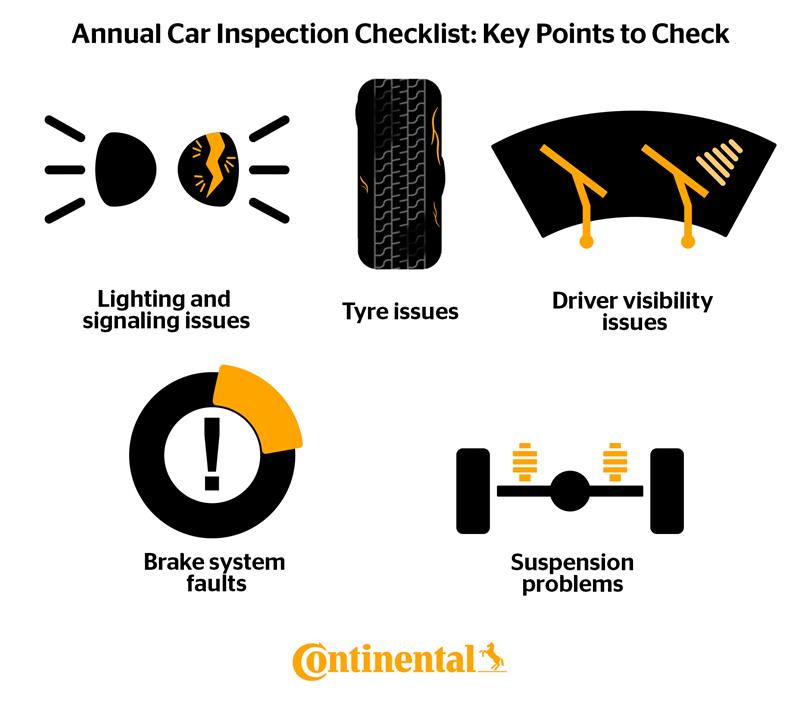
Many owners find that their vehicles fail inspection due to a minor issue, which often could have been spotted and dealt with ahead of time. By being aware of the most common MOT inspection failure points, you can help prevent them, potentially saving yourself time, money, and hassle. Here are some of the most common failure points:
Tyres are key to handling, stopping, and keeping your vehicle safe in all seasons. If you have worn or damaged tyres, you are more likely to fail your vehicle inspection. These are the most common problems inspectors identify:
If your car fails its MOT, it is because the vehicle doesn’t meet roadworthy standards and cannot be driven safely. You’ll be provided with a detailed report outlining the defects that need to be repaired for your vehicle to be considered roadworthy.
In the UK, failures are categorised as dangerous, major, or minor. If your vehicle fails, you can either drive it to a repair location or have the repairs done at the same test centre.
If you return to the test centre within 10 working days, a partial retest can be conducted that covers only the issues listed in your report. After 10 working days, a full MOT test is required. Even if you have a minor failure, such as a damaged number plate, and you're wondering, can you drive without MOT clearance, the answer is a firm no.
The average time for an MOT test is 45 minutes to an hour. If you have a small, simple car, it might only be about 30 minutes. Larger vehicles like vans can take up to 1.5 hours.
You can book your MOT at one of hundreds of test centres, online, or in person. Local council websites also offer vehicle inspection bookings.
You have to take your vehicle to an MOT-approved test centre. There are hundreds of them all around the country. Note that these facilities must display a blue sign with three white triangles to confirm that they are MOT-approved.
The UK government has set maximum costs for MOT inspections. For standard cars and dual-purpose vehicles that carry up to eight passengers, the price is £54.85 in 2026. Motorcycles cost £29.65.
If you miss your MOT deadline, you will not be allowed to drive your vehicle other than to a new, pre-arranged MOT test. You should book this as quickly as you can.
Yes, you can drive your vehicle to a pre-booked MOT appointment once you've addressed the issues that caused it to fail. You may also drive it to a pre-arranged repair appointment to have it fixed before taking the test again.
If you leave your vehicle at the test centre to be repaired and have it retested within 10 working days, you won't pay anything. If you take your vehicle away for repairs and return it for a retest within 10 working days of failure, you may pay a partial retest fee, which is typically half the cost. In all other cases, a retest will cost you the same as the original test.
No, you can take your vehicle to any test centre for a retest. However, if you leave it at the same test centre for repairs and have it retested within 10 days, you'll typically avoid paying extra fees.
Yes, the same laws and regulations apply to electric cars.
Tyres must be the same on each axle. If you mix tyre construction types or sizes on the same axle, you'll automatically fail your MOT.