


# Know How
Winter regulations
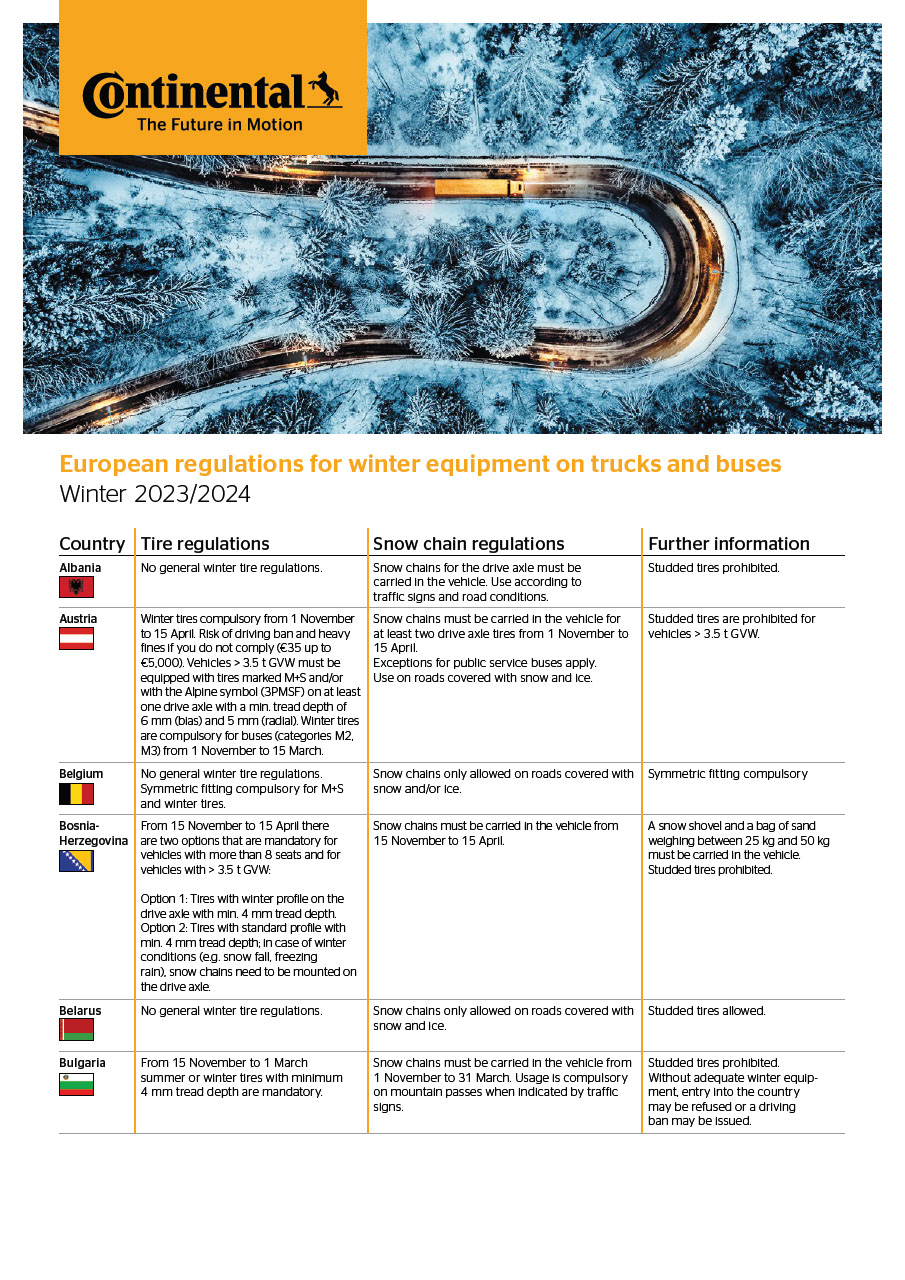
European regulations for winter equipment on trucks and buses
European regulations for winter equipment on trucks and buses - Winter 2023/2024
| Country | Tyre regulations | Snow chain regulations | Further information | |
|---|---|---|---|---|
Albania | No general winter tyre regulations. | Snow chains for the drive axle must be carried in the vehicle. Use according to traffic signs and road conditions. | Studded tyres are prohibited | |
Austria | Winter tires compulsory from 1 November to 15 April. Risk of driving ban and heavy fines if you do not comply (€35 up to €5,000). Vehicles > 3.5 t GVW must be equipped with tyres marked M+S and/or with the Alpine symbol (3PMSF) on at least one drive axle with a min. tread depth of 6 mm (bias) and 5 mm (radial). Winter tyres are compulsory for buses (categories M2, M3) from 1 November to 15 March. | Snow chains must be carried in the vehicle for at least two drive axle tyres from 1 November to 15 April. Exceptions for public service buses apply. Use on roads covered with snow and ice. | Studded tyres are prohibited for vehicles > 3.5 t GVW. | |
Belgium | No general winter tyre regulations. Symmetric fitting compulsory for M+S and winter tyres. | Snow chains only allowed on roads covered with snow and/or ice. | Symmetric fitting compulsory | |
Bosnia- Herzegovina | From 15 November to 15 April there are two options that are mandatory for vehicles with more than 8 seats and for vehicles with > 3.5 t GVW: Option 1: Tyres with winter profile on the drive axle with min. 4 mm tread depth. Option 2: Tyres with standard profile with min. 4 mm tread depth; in case of winter conditions (e.g. snow fall, freezing rain), snow chains need to be mounted on the drive axle. | Snow chains must be carried in the vehicle from 15 November to 15 April. | A snow shovel and a bag of sand weighing between 25 kg and 50 kg must be carried in the vehicle. Studded tires prohibited. | |
Belarus | No general winter tyre regulations. | Snow chains only allowed on roads covered with snow and ice. | Studded tyres allowed. | |
Bulgaria | From 15 November to 1 March summer or winter tyres with minimum 4 mm tread depth are mandatory. | Snow chains must be carried in the vehicle from 1 November to 31 March. Usage is compulsory on mountain passes when indicated by traffic signs. | Studded tyres prohibited. Without adequate winter equipment, entry into the country may be refused or a driving ban may be issued. | |
Croatia | Winter tyres compulsory from 15 November to 15 April. M+S tyres are compulsory on the drive axle of vehicles > 3.5 t GVW. | Snow chains required for the drive axle in certain conditions (if the vehicle is equipped with SU tires). Snow chains compulsory in some regions (Lika/Gorski Kotar). | Studded tyres prohibited. Commercially used vehicles must carry a snow shovel. | |
Czech Republic | Winter tyres compulsory from 1 November to 31 March depending on road conditions in winter, or if indicated by „winter kit“ sign. M+S tyres with min. 6 mm tread depth must be fitted on the drive axle of vehicles > 3.5 t GVW. | Differing traffic signs possible. Snow chains are compulsory if indicated by traffic signs on at least 2 drive wheels of vehicles with 3 or more axles. | Studded tyres prohibited. | |
| Denmark | No general winter tyre regulations. | Snow chains allowed from 1 November to 15 April. | Studded tyres allowed from 1 November to 15 April. If fitted, studded tyres should be mounted on all axles during this period. | |
| Estonia | Winter tyres compulsory for vehicles < 3.5 t GVW (radial tyres with min. 3 mm tread depth) from 1 December to 1 March (also from October to April depending on weather). Heavier vehicles do not require winter tyres, but minimum tread depth of 3 mm is mandatory. | Snow chains are compulsory if indicated by traffic signs on at least 2 drive wheels of vehicles with 3 or more axles. | Studded tyres allowed between 15 October and 31 March. | |
| Finland | Mandatory winter tyres from 01.11-31.03, if winter conditions; on non-steering drive axles 3PMSF or POR or studded tyres. M+S marked tyres allowed until 30.11.2024 On drive axle min. 5 mm and all other axles min. 3 mm tread depth. | Snow chains only allowed on roads covered with snow and ice. | Studded tyres allowed between 1 November to 31 March if winter conditions prevail. | |
| France | Winter equipment is mandatory for vehicles driving on roads marked with the B26 and/or B58 sign. The following changes apply from 2021: From 1 November to 31 March, at the discretion of the local authorities (préfectures), N1/N2/N3 vehicles with trailers to be fitted with removable anti-skid devices (e.g. snow chains) at least 2 driven wheels. N1/N2/N3 vehicles without trailers to be fitted with 3PMSF winter tyres at least 2 wheels of each axle. Bus M2/M3: To be fitted with removable anti-skid devices at least 2 driven wheels or (3PMSF winter tyres on the front steer axle and at least 2 driving wheels). There is a transition period until November 2024 for M+S tyres already in use. | Use of snow chains when indicated by traffic signs. | VVehicles < 3.5 t GVW: Studded tyres allowed from 1 November to 31 March, max. speed 90 km/h. Vehicles with studded tyres have to be labelled with a sticker. Studded tyres are prohibited for vehicles > 3.5 t GVW. | |
| Germany | In wintry weather conditions vehicles with > 3.5 t GVW must be fitted with tyres marked with 3PMSF at the wheel positions of the permanently driven axles and front steering axles. M+S tyres produced before 1 January 2018 are accepted until 30 September 2024. | Use of snow chains when indicated by traffic signs. Studded tyres prohibited. Exception: Route via “Kleines Deutsches Eck”. | €60 fine for unsuitable tyres; €80 fine for causing obstruction/disturbance of traffic due to unsuitable tyres; €100 fine for causing hazardous situation due to unsuitable tyres; €120 fine for causing an accident due to unsuitable tyres. Plus 1 point in each case (Flensburg points system). | |
| Great Britain | No general winter tyre regulations. | Snow chains only allowed on roads covered with snow and ice. | Snow chains only allowed on roads covered with snow and ice. | |
| Hungary | No general winter tyre regulations. | Snow chains only allowed on roads covered with snow and ice. It may be compulsory to apply and carry snow chains under certain weather conditions (max. speed: 50 km/h). In wintry conditions, foreign vehicles may be denied access if no snow chains are carried on board. | Studded tyres prohibited. | |
| Iceland | Winter tyres are not strictly mandatory. Tires must have at least 3 mm tread depth over the winter period (1 November to 14 April). | Snow chains are forbidden in conditions where they can cause damage to roads. | Studded tyres allowed part of the year (1 November to 14 April). | |
| Ireland | No general winter tyre regulations. | Snow chains only allowed when roads covered with snow and ice. | ||
| Italy | No general winter tyre regulations. Exceptions are indicated by traffic signs. | An anti-skid device (e.g. snow chains) must be carried in the vehicle. | ||
| Kosovo | From 15 November to 15 March, transport vehicles ≤ 3.5 t GVW must use winter tyres (M+S marked) on all wheels, or summer tires with minimum tread depth of 4 mm and with snow chains placed on driven wheels. Buses and transport vehicles > 3.5 t GVW must use snow chains or winter tyres (M+S marked) on driven wheels. | Snow chains allowed on driven wheels. | Studded tyres prohibited. | |
| Latvia | Winter tires (M+S) compulsory for vehicles < 3.5 t GVW from 1 December to 1 March. Minimum 4 mm tread depth. Heavier vehicles do not require winter tyres, but a minimum tread depth of 3 mm is mandatory. | Snow chains only allowed on roads covered with snow and ice. | Studded tyres allowed between 1 October and 30 April for vehicles > 3.5 t GVW. | |
| Liechtenstein | No general winter tyre regulations. However, there are liability issues if unsuitable tyres are used. The vehicle equipment must be suitable for the weather conditions. | Snow chains allowed. Not necessary in valleys. In the mountains, traffic signs indicate if snow chains are compulsory. | Vehicles > 7.5 t GVW: Studded tires allowed from 1 November to 30 April, max. speed 80 km/h. If fitted, all tyres should be equipped with studs. Vehicles with studded tyres have to be labelled with a sticker. | |
| Lithuania | Winter tyres compulsory for vehicles < 3.5 t GVW from 1 November to 1 April. Heavier vehicles do not require winter tyres, but a minimum tread depth of 1.6 mm is mandatory. | Snow chains only allowed on roads covered with snow and ice | Studded tyres allowed between 1 November and 1 April. | |
| Luxembourg | All drive axles on trucks and buses need to be equipped with winter tyres (M+S suffices) during winter conditions (snow, ice, glazed frost). | Snow chains only allowed on roads covered with snow and ice. | Studded tyres prohibited | |
| Macedonia | No general winter tyre regulations. | Snow chains must be carried in the vehicle from 15 October to 15 March if the vehicle has only standard tyres fitted. | Coaches and heavy trucks must carry snow shovels. Studded tyres prohibited. | |
| Montenegro | Tires marked with the M+S symbol or winter tyres compulsory from November to April on specific roads, specified by Ministery of Police. Min. 4 mm tread depth. | Snow chains for the drive axle must be carried in the vehicle. Use according to traffic signs and conditions. | Studded tyres prohibited. Buses and trucks must carry a snow shovel. | |
| Netherlands | No general winter tyre regulations. | Snow chains not allowed on public roads. | Studded tyres prohibited. | |
| Norway | Vehicles > 3.5 t GVW must be fitted with winter tyres from 15 November until 31 March: 3PMSF tires on drive axle and front steer axle, M+S or 3PMSF tyres on free roling axles. Depending on the region, tires must have min. 5 mm tread depth during the winter season. In south Norway: between 1 November and first Monday after Easter. In north Norway: between 16 October and 30 April. | It is mandatory for vehicles > 3.5 t GVW to carry snow chains in the period when it is legal to use studs. A truck with trailer must carry 7 chains. | Studding only allowed on winter tyres. Studded tires (average protrusion: 1.7 mm) allowed from 1 November to the first Sunday after Easter. In Nordland, Troms and Finnmark: from 16 October to 30 April. Trucks and trailers: studded tyres on the same axle. If twin-mounted, one tyre is sufficient. In Trondheim and Oslo a fee is charged for the usage of studded tyres: daily tickets may be acquired at vending machines along the arterial roads or by telephone or text message (send from a Norwegian, Swedish or Danish telephone number). Monthly and annual tickets for Trondheim may be acquired at Trondheim City Parking Office in Erling, Skakkes Gate 40, 7012 Trondheim. Daily tickets cost about €3.90, monthly tickets about €52 and annual tickets about €155 (costs double for vehicles > 3.5 t GVW). A violation is fined with €97 | |
| Poland | No general winter tyre regulations. | Snow chains only allowed on roads covered with snow and ice. Adequate traffic signs on roads where snow chains are compulsory. | Studded tyres prohibited. | |
| Portugal | No general winter tyre regulations. | Snow chains temporarily compulsory when indicated by traffic signs (high-altitude regions only). | Studded tyres prohibited. | |
| Romania | In case of wintry road conditions M+S or winter tyres are compulsory for the drive axle of all vehicles > 3.5 t GVW and vehicles transporting people (with more than 9 seats). | Vehicles > 3.5 t GVW have to be equipped with snow chains which need to be mounted when indicated by respective traffic signs. | Shovel and sand required for vehicles > 3.5 t GVW. Studded tyres prohibited. | |
| Russia | In December, January and February, passenger light truck, trucks and buses must be equipped on all axles with tyres marked M+S or with the 3PMSFSymbol (Three-Peak Mountain Snowflake symbol) Minimum tread depth: 4 mm. | Snow chains are recommended but not compulsory | Use of studded tyres is forbidden in the summer months (June, July, August). | |
| Serbia | Winter tyres (M+S) and min. 4 mm tread depth compulsory from November to April. Use according to traffic signs and conditions. | Snow chains for drive axle must be carried in the vehicle. Use according to traffic signs and conditions. | Studded tyres prohibited. Buses and trucks must carry a snow shovel. | |
| Slovakia | Winter/M+S tyres compulsory for trucks > 3.5 t GVW from 15 November to 31 March on the drive axle (min. 3 mm tread depth). | Snow chains must be carried in the vehicle. Use according to traffic signs and conditions. | Studded tyres prohibited. | |
| Slovenia | From 15 November to 15 March there are two options that are mandatory on vehicles > 3.5 t GVW: Option 1: winter tyres at least on the drive axle (min. 3 mm tread depth) Option 2: standard tires, but chains must be carried in the vehicle to be mounted on the drive axle in case of winter conditions. | Snow chains must be carried in vehicles > 3.5 t GVW if no winter tires are fitted. | Studded tyres prohibited. | |
| Spain | High mountain roads with red level (15/TV-87): Buses can drive with tyres marked with the 3PMSF symbol (ThreePeak Mountain Snowflake symbol) in all positions and minimum tread depth 4 mm. Rigid trucks between 3.5 t and 7.5 t GVW only for garbage collection, food distribution, transport of fluxes and assistance vehicles can drive with winter tyres in all positions and minimum tread depth 4 mm. Other trucks not allowed to drive. | High mountain roads with red level (15/TV-87): Snow chains in rigid trucks between 3.5 t and 7.5 t GVW and buses, if no winter tyres are fitted. | Usage of studded tyres with up to 2 mm studs are allowed on snow-covered roads. | |
| Sweden | In wintry weather conditions, minimum tread depth is 5 mm on all axles except trailers (1,6 mm). Vehicles > 3.5 t GVW must be equipped with 3PMSF, POR or studded tyres on front and drive axles, on other axles M+S tyres are also allowed. Until 30 November 2024, it is allowed to use M+S (specially developed for winter) on all axles. | Snow chains recommended to be carried in the vehicle. | Studded tyres are allowed from 1 October to 15 April. Depending on the weather conditions this period may be extended. Maximum of 50 studs per meter circumference in tires produced after 1 July 2013. Please note exceptions on specific roads. | |
| Switzerland | No general winter tyre obligation exists. However, the vehicle must be equipped according to the road conditions and be safe to operate. If unsuitable tyres were fitted in case of an accident, be aware of potential liability issues (e.g. limited insurance benefits). In winter conditions, situational regulations (snow chains) are possible, e.g. on Alpine passes. | Use of snow chains in case of respective road signs and conditions. | Studded tyres are allowed for vehicles < 7.5 t GVW between 1 November and 30 April on snow-covered roads. Max. speed 80 km/h. Studded tyres have to be labeled with a sticker 80 km/h. | |
| Türkiye | It is obligatory to equip vehicles used for passenger and goods transport with winter tyres on regional roads for 4 months between December 1st and April 1st. Within the provincial borders, local governors decide whether to enforce winter tyre regulation and make necessary announcements according to average local temperatures. It is obligatory to fit winter tyres on drive axles of trucks, tractors, tankers and buses, and on all axles of light trucks, vans and taxis, minibuses, vans and commercial cars. Any tyre to be replaced on the road has to be replaced with a winter tyre. Within the obligatory period, winter tyres should bear (M+S) symbol or snowflake symbol (3PMSF) or both on the sidewall. The tread depth and pattern of retreaded tyres should comply with winter tyres even if they bear (M+S) symbol on the shoulder. Winter tyres should have a tread depth of min. 4 mm for trucks, tractors, tankers and buses and 1.6 mm for light trucks, vans and cars. | Having or using a tyre chain with the vehicle does not absolve drivers from their obligation to use winter tyres. | Only studded tyres that can be used on ice can substitute winter tryes. The tread depth should be measured from the tread center. | |
| Ukraine | No general winter tyre regulations. | Snow chains only allowed on roads covered with snow and ice. | Studded tyres are allowed. |
We are currently not aware of general winter tyre rules / snow chain regulations for trucks in the following countries: Cyprus, Greece and Malta. Please consult the traffic regulations in the respective countries for special snow chain and studded tire rules.
Despite careful research, we cannot guarantee that the information is correct and complete.
Tyres marked with M+S (Mud+Snow) provide a tread pattern or structure that is designed to deliver performance that exceeds that of a standard tyre in snowy conditions. The M+S label is not subject to a defined test procedure.
Three-Peak Mountain Snowflake (3PMSF) tyres deliver winter performance that is legally certified. These tyres have to pass a test on a snow-covered road and have at least 25% better traction than a standard reference tyre.
Winter tyres from Continental are marked with the snowflake symbol on the tyre wall. Not only do Continental winter tyres easily outperform M+S tires, they also significantly exceed the requirements of the “Three-Peak Mountain Snowflake“ symbol (3PMSF). The development of winter tyres from Continental is based on many years of experience and practical knowledge gained from using the tyres in the low temperatures found in Scandinavian countries. These special winter tyres offer a distinct advantage for a safe journey on snow-covered or icy roads.
For optimum traction and high driving safety in colder weather, Continental recommends fitting winter tyres on all axles of your trucks and buses.